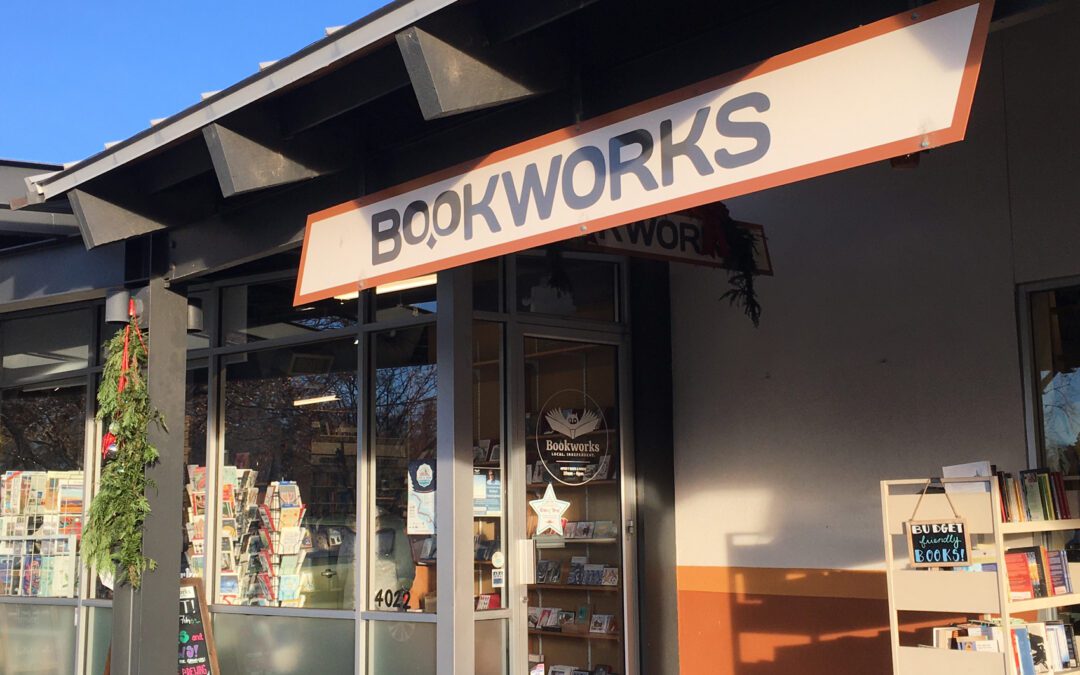
This is my tenth holiday shopping season as a bookseller, at locally-owned independent Bookworks in Albuquerque, New Mexico. It also happens to be my first as a partner in the shop.
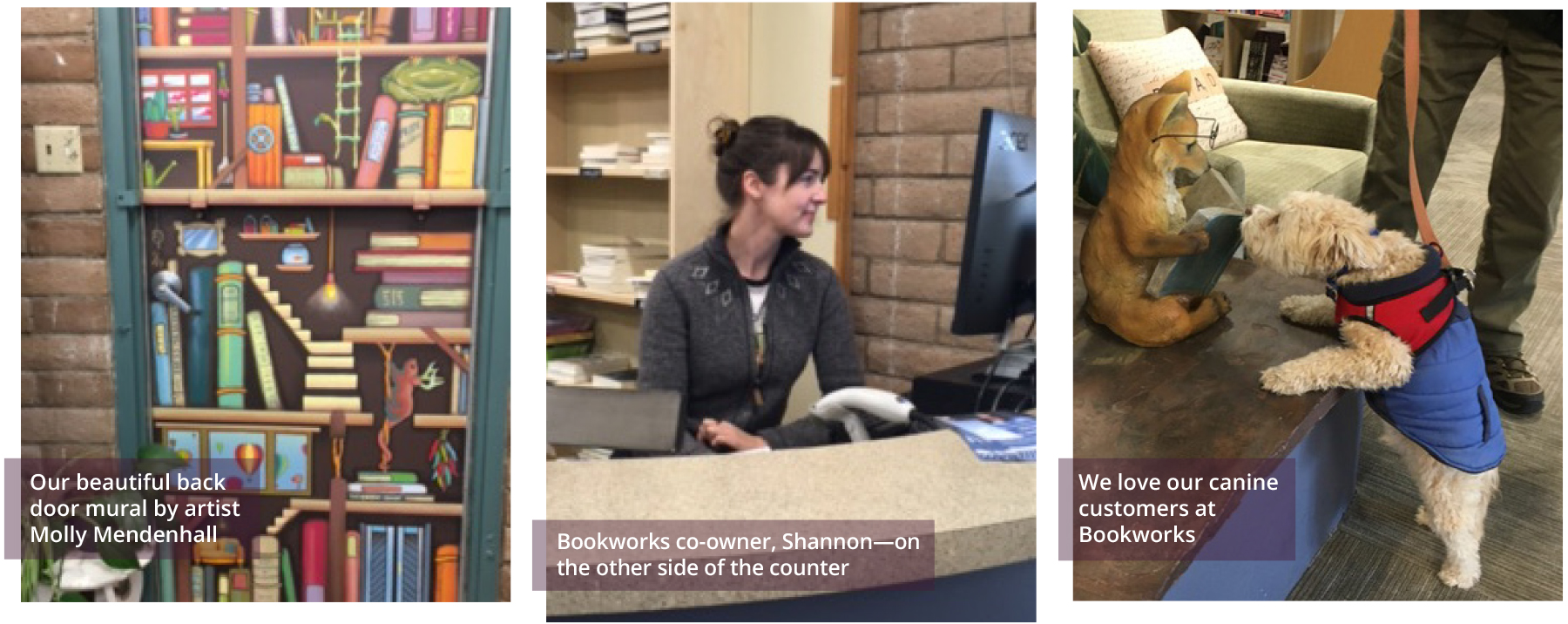
On January 1, 2023, Bookworks changed hands, and is now a partnership with the managing partners being the brilliant daughter-mother team of Shannon Guinn-Collins and Nancy Guinn—and a group of investors from the community, including myself, rounds out the team. Bookworks is truly a community effort!
It has been a year of learning and growing (we have about 30% more books in stock!), updating computers and training staff on new systems, re-starting author events after the pandemic (we’ve hosted authors from near and far in the store and Pulitzer Prize winner Colson Whitehead was in conversation with former Albuquerque Poet Laureate Hakim Bellamy at the Kimo Theater in downtown in July…and more to come, including Pulitzer Prize winner, Michael Cunningham at the Main Albuquerque Public Library in January (get your tickets here), brightening the store’s colors and adding murals—I am prouder than ever to be a part of the Bookworks crew.
And speaking of crews, it’s all hands on deck for the holiday shopping season. I hope to be happily exhausted when we lock the doors on Christmas Eve. This season can make, or break, the year for a small business, so please SHOP SMALL and SHOP LOCAL!
Of course, I’m biased, but books sure do make great gifts. Talking with customers, helping them find books their loved ones will love, is my favorite part of this work. And there’s still time to order books, if we don’t happen to have the one you want (but not much time…at Bookworks, we’ll get books into the store in time for Christmas if you order by December 13th). Shop with us, or at your favorite local independent bookstore—we make a real difference in all our communities!
And remember, those of us on the other side of the counter are pushing pretty hard right now to get you what you really want, so please be patient with us while we do.
Happy holidays, everyone! See you on the other side…of the counter, and of the holiday rush.
In the few quiet moments this week, I find myself …
I was going to continue that sentence, but the pen in my hand simply hovered over the page, stopped by I don’t know what… And unlike me, I heeded the pause. Finally, I decided—a period after ‘myself’ was the best end to that sentence.
IN THE QUIET MOMENTS, I FIND MYSELF.
That was the message I needed to write—to me, for me. (And maybe for you too?)
I like to think I’m a generous person, and I also need to remember that I have more to give when I feel grounded, solid, and strong—in myself. That in this quiet moment those words unspooled on the page feels like a huge gift. And I am grateful for it. I hope I remember to carry it with me every single day.
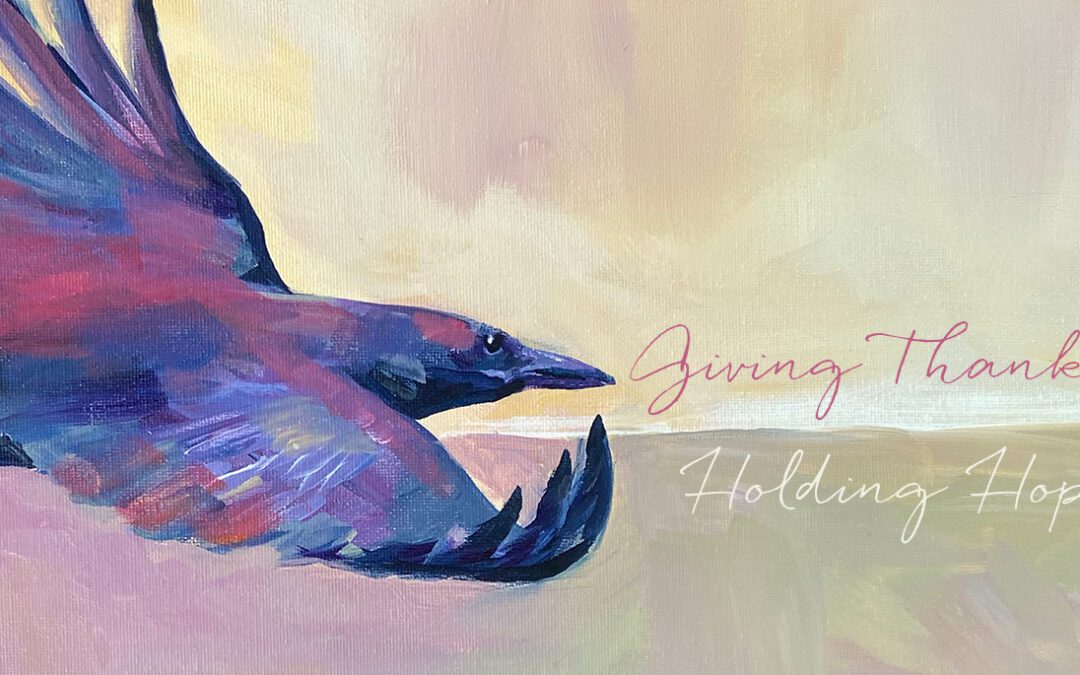
So, I give thanks, for so much that is good in my life, and in the world. And I hold hope, because I choose to hope, rather than to despair, at least in this moment—for more good, for more love, for more peace—in myself, and in the world.
In whatever way you want, or need, to answer—WHERE/HOW DO YOU FIND YOURSELF?
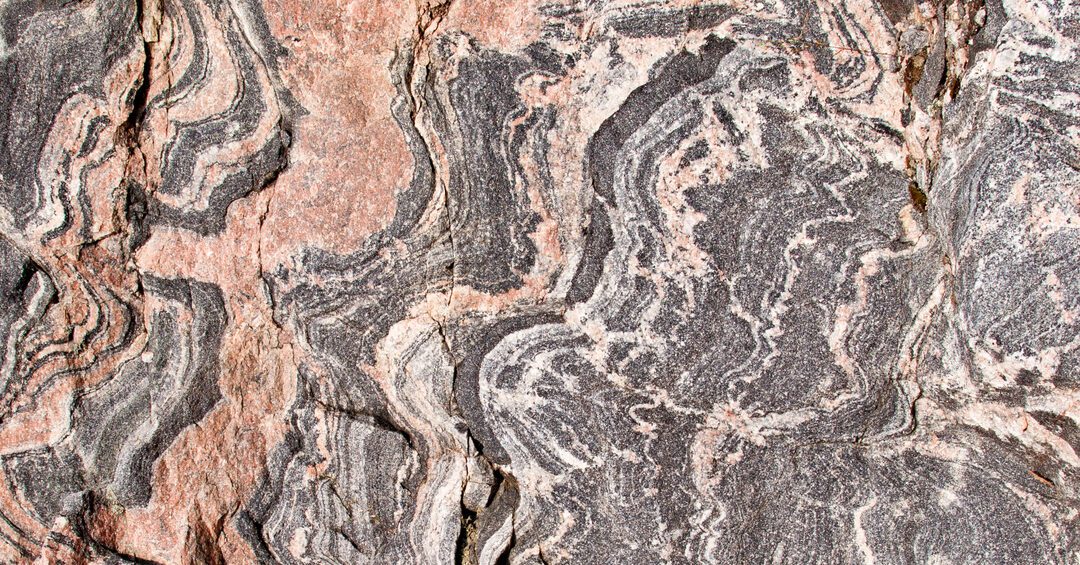
[For my non-geological readers—gneiss is pronounced nice]
In March of 2019, during my term as the Richard H. Jahns Lecturer, I had the honor of speaking at the Seattle Science Center for their Science in the City series. The Q&A following my talk wound up with a girl of about 12 years asking, “What rock would you describe yourself as?”
Most of my Jahns presentations were given at Geology Departments at colleges and universities where students asked about technical aspects of the work or the logistics of jobs in our profession. To say I was not prepared for the girl’s question that evening would be an understatement. But what geologist wouldn’t love a question like that? I took a moment, took a breath, then said, “Gneiss.” After pausing to enjoy the ripple of laughter from the audience, I elaborated.
Although I do hope that at least a few people consider me nice, that wasn’t why I chose it. A metamorphic rock, gneiss is formed when another rock is recrystallized due to intense heat and pressure. Metamorphosis is a process of transformation. I like to think that I, and my life, have been transformed by the heat and pressure withstood over my lifetime. It’s a metaphor, of course, for no human could survive the conditions that recrystallize stone, but there are times I wonder how we survive the conditions that confront us day to day, year to year. Yet, so often we do.
And like gneisses—varied in composition and color, often beautiful, with minerals aligned in bands, sometimes straight and sometimes contorted—our lives may be metamorphosed into complex structures, layered in light and dark, sparkling in certain light. I also like to think that the components of my life—my home, my sailboat, my work, my volunteer activities, what I eat, how I dress, the car I drive, how I spend my time and money, in sum, my values—like the minerals that form gneiss, have been arranged and rearranged as stresses have acted on me.
We don’t always get to choose what precipitates our metamorphoses, but like rocks transformed at depth whose minerals gleam when unearthed, we too can shine, having recrystallized into who we are now, knowing that we can only be that for the heat and pressure we have endured. Our stories, geological or human, shape us.
Today, a dear friend told me of a metamorphic event that is occurring in her life. Already strong and beautiful, I know she will persevere. And I trust she will emerge, transformed, in some way different than she began, but no less exquisite, and maybe more so.
It is a gneiss life, indeed.
But maybe you would choose a different rock, for a different reason, and so I ask:
I’m not sure why the simplest joys in my life, some very present and others in memory, are what I am reflecting on today, perhaps because there is so much that is complex and troubling to read and think about in the wider world right now. I often write of balancing thoughts and feelings—like connecting with gratitude for my personal and professional life, while acknowledging deep concern, even terror, for what is churning worldwide. And though these joys may be simple ones, some are, or were, not at all easy to come by. Feeling able to savor them is, indeed, a gift.
So here’s a partial list of simple joys I woke feeling the urge to scribble down this morning:
The love of the best dogs (well, they were MY best dogs)
Gazing upon the Sandia Mountains each morning the moment I open my eyes
All the time I get to spend in nature
Waking up healthy, if a bit more creaky than in my younger years, and still being able to touch my toes
Having a sturdy brace that allows me to continue backpacking despite a torn-up left knee
Birds (especially those that grace me with their presence, and songs, here in the desert and on the boat)
Swirling in self-doubt for a day, instead of a month or a year (thanks to insightful therapists)
Family who are friends and friends who are (chosen) family
Love, period
On this complicated day, what are some of your simple joys?
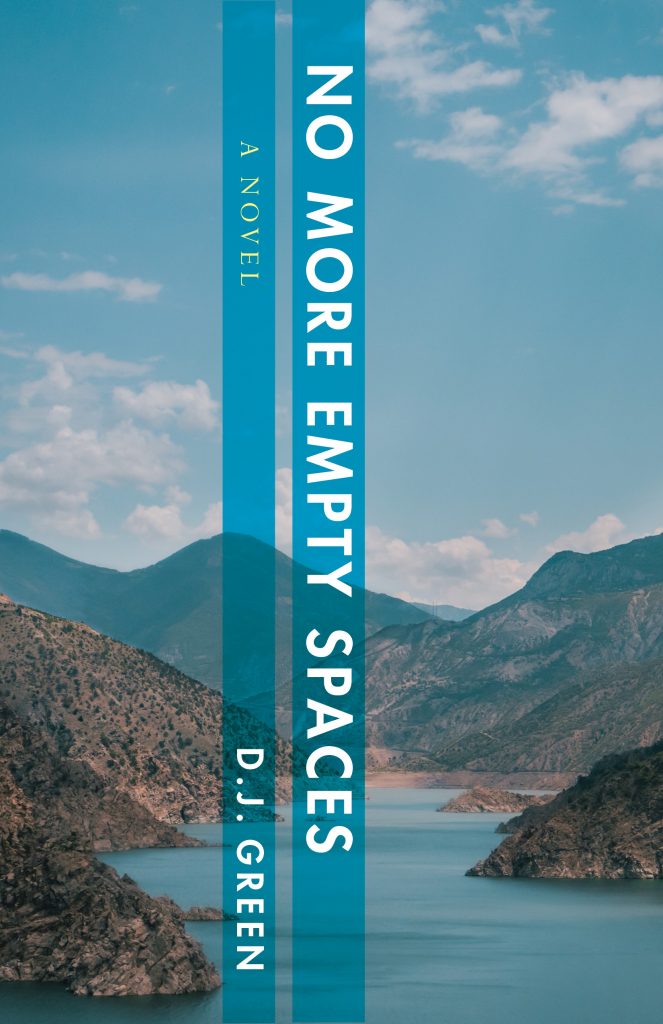
For this writer, the last leg of the long journey to getting my first novel into readers’ hands has begun. NO MORE EMPTY SPACES will be published by She Writes Press on April 9, 2024. Pretty exciting!
What’s also exciting is that it’s available NOW for pre-order wherever fine books are sold. As a staunch supporter of local independent booksellers, I encourage you to pre-order yours from your favorite indie bookstore.
Here’s a link to NO MORE EMPTY SPACES at Bookworks, my favorite indie bookstore (it’s been my favorite for decades, and I liked it so much that I went from a bookseller there to a partner in 2023). If you don’t happen to live in Albuquerque, no worries, they can ship it anywhere in the U.S.
If you prefer, you can also order it through Bookshop, an online shopping platform that supports local independent bookstores across the U.S. Don’t forget to “Choose a Bookstore” when you order.
About NO MORE EMPTY SPACES:
New Jersey, 1973, and Will Ross discovers that his three children are not being cared for by his ex-wife, whose escalating alcoholism has rendered her unable to parent. He’s just landed an exciting new job in Turkey; he’ll work as a geologist on the troubled construction of a dam in the remote, rugged, and beautiful Anatolian mountain region. Determined to get to Turkey, yet also protect his children, Will takes the kids along for what they think is their customary two-week stint of shared custody. He doesn’t share that he has no plans to send them home.
So begins this novel—part-adventure, part-geological tale, part-travelogue, part-family saga—a gripping, heart-rending story about the forces we can control, and those we can’t.
Geologists study the earth and the processes that shape it. Writers study the human heart and the processes that shape it. The GeologistWriter builds a bridge between the two. Come across it with me!



Recent Comments