
by D. J. Green | Jan 16, 2017 | Ground Work
Waking before dawn with today’s to-do’s scrolling through my mind, I felt choked up just brewing a cup of tea – compile tax info, update Dad’s expenses, call the accountant, brush the dog, vacuum up the dog hair, do the laundry, work a closing shift at the bookstore, and oh yes, how’s the re-write of that novel I’ve been working on for years going….
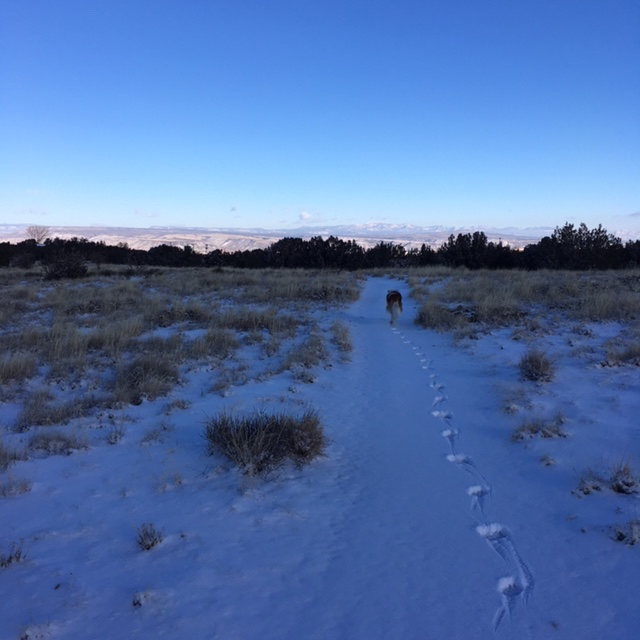
I drank my tea, trying to swallow the anxiety spawned by the news and to-do’s along with it. Then Sandy and I headed out for our walk. He led me up the trail at sunrise, his fur ruffling in the chill breeze, his too-small-for-his-body ears bouncing with each step. A flock of Mountain Bluebirds, wintering in the junipers, took to the sky as we passed, the incredible color of their feathers flashing.
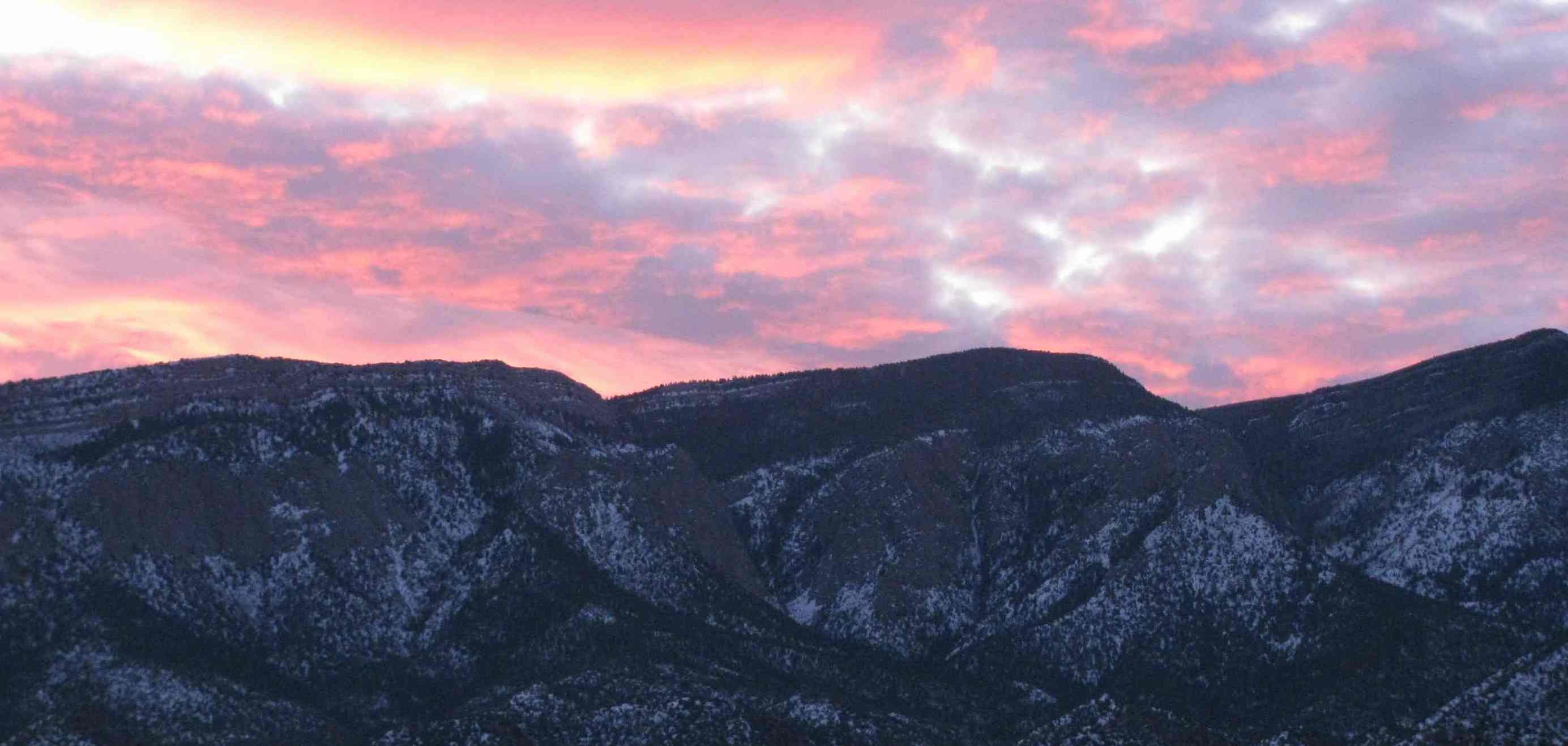
The Sandia Mountains tower 5,000 feet above our mile-high home, and we walk in their shadow. The banded uppermost layer is 300 million-year-old Madera Limestone, deposited in an ancient sea where crinoids and brachiopods and bryozoans flourished (creatures that still inhabit our oceans today, though in different forms). But the range is dominated by the Sandia Granite, a 1.4 billion-year-old formation (yes, billion!). Its reddish pink orthoclase feldspar crystals make the mountains glow, gold shading to deep pink, as the sun angle lowers late in the day, giving the range its nickname – the Watermelon Mountains.
The views – of a billion years of time and thousands of feet of displacement on the faults that form the Rio Grande Valley – remind me to lighten up; my whole lifetime is less than a snap of the fingers in the story of this landscape. My ashes will one day be scattered in the arroyo beside my house, and I will be carried to the river and beyond. My adobe house will melt back into the earth, leaving hardly a trace for whoever or whatever inhabits this space down the track of geologic time.
Politics won’t matter. Money won’t matter. The stuff by which we define success, or failure, won’t matter. I don’t have to take life, and myself, so seriously. I’m free to explore and take chances. I can stand up for what matters to me, without thinking that one way or the other it’s the end of the world. Geologic time proves to me it won’t be.
When I remember to live like that, in addition to having the courage to try, whether I succeed or fail, there’s also space to savor the finger snaps of my own lifetime – a walk with my beloved dog, making tracks in fresh snow, Sirius sparkling in a black velvet sky, Wynton Marsalis playing Where or When, a hawk soaring overhead, reading Mary Oliver’s Wild Geese, and the glint of a mountain moonrise. In those moments, my heart fills with gratitude – it feels physical, like my heart is actually swelling in my chest. Have you ever felt it?
I can’t imagine it being expressed any better than Oliver Sacks did in one of his last essays, My Own Life, “Above all, I have been a sentient being, a thinking animal, on this beautiful planet, and that in itself has been an enormous privilege and adventure.”
by D. J. Green | Dec 20, 2016 | Venus & Mars Go Sailing
I feel like I’m going in three directions at once these busy holiday days, all at 75 miles per hour. It got me thinking about life on the boat, where 6 knots (that’s almost 7 mph) under sail feels fun and fast.
On an early July day last summer, Eric, his son John, and I were sailing south in Plumper Sound in the Southern Gulf Islands of British Columbia. We were on a beat, sailing upwind, making slow forward progress by tacking back and forth down the channel. In about 10 knots of wind, we moved along at 3 to 4 knots of boat speed. For context, 1 knot = 1.15 miles per hour. Boat speed is also called speed over water (which means that’s how fast the boat is moving through the water, not counting the current either pushing you along toward your destination or flowing against you keeping you from getting to your destination). Speed over ground, which is a way of saying how fast you’re getting from Point A to Point B, is the boat speed plus or minus (depending on which way the current is going) the speed of the current itself. That’s an oversimplification, but I hope you get the idea.
That day we wanted to sail (not motor) even if the wind was light, so we’d planned to haul anchor at a time in the tide cycle when we’d have the current with us, helping us along. Easing down Plumper Sound our speed over ground was 1 to 2 knots faster than our speed over water. Our plan for the day’s sail from Winter Cove to Bedwell Harbour was going well.
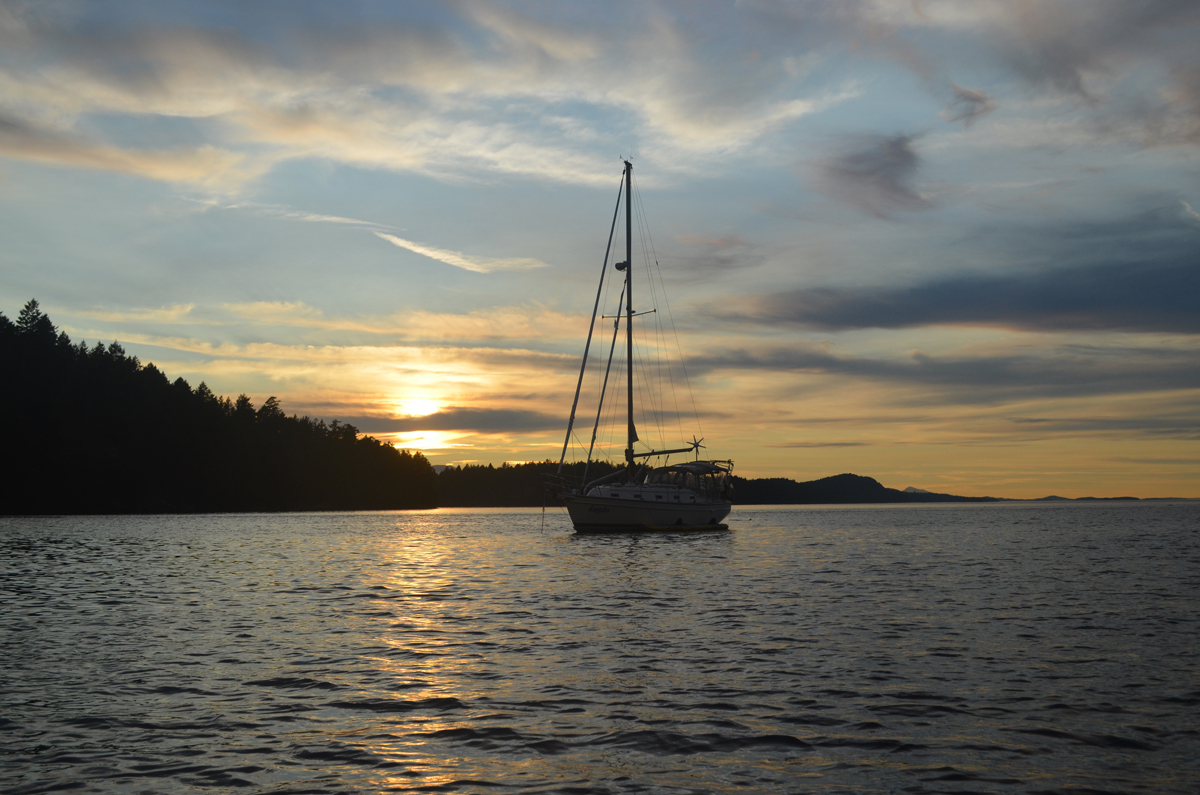
Kagán under sail
As we turned to starboard, to the southwest, into Boundary Pass, the wind eased. It was already pretty easy, then it dropped to 6 knots or less. We slowed. More. Boat speed fell to less than 2 knots. I’ve heard “under 3, turn the key” many times. The “3” meaning 3 knots and “turn the key” meaning furl your sails, turn your engine on, and motor to wherever you’re going. This applies to coastal cruising, which is what we do, not crossing oceans, which is another story altogether.
We considered motoring on to our marine park destination for an afternoon hike. But the quiet was so sweet, the sails were still full, and the current was still with us, so we kept ghosting along through the glassy water.
Then we heard it, pffft. I swung my head around. Where had the sound come from? Pffft. Again. And again. Harbour Porpoises! The smallest of the porpoises. Shy, unlike the more gregarious species that also frequent these waters, like Pacific White-Sided Dolphins who will swim right up to your boat and ride bow waves. Usually these graceful creatures don’t come this close to the boat. But usually we don’t go this slow, move this silently.
There were six of them – two off our port side, two swimming along with us in the tiny wake behind our dinghy, and two ahead.
I always thought they were deep black in color, as I’d only seen their silhouettes in the distance. But that day, I saw their skin is dappled and shaded, like the brindled coat of a dog, from brown to gray to black. Nuanced and beautiful.
And as I always seem to do when I see porpoises or dolphins or whales, near or far, I danced around the cockpit, I clapped my hands, I clasped them over my heart – delighted and reverent. I didn’t notice whether Eric and John joined in the thrill or thought I was crazy. It didn’t really matter.
Eventually, their blows grew fainter on the dying breeze, their sleek backs arched in and out of the water farther and farther from us. Becalmed, we furled our sails and motored on to the anchorage.
But what a gift we’d received – our slow passage a form of patience – an invitation to Kagán and her crew to ride the barely-there breeze escorted by a pod of porpoises. Recalling that feeling reminds me to tap into patience and go slow, even for a brief moment in a busy day.
by D. J. Green | Jun 10, 2016 | Ground Work
…to accept what is.
My old dog, Sandy, is almost thirteen. We walk together nearly every day on the trails at the base of the Sandia Mountains for which he is named. These days his walk can wobble. When a jackrabbit crosses his path, he speeds up to a teetering trot, still on the chase. In those moments, I think of his younger days when he could almost catch the racing rabbits, his strides long and fluid and so, so fast. But he doesn’t turn to me and lament the bygone days. He seems to love every minute of every walk we take. He doesn’t fret over his evermore frequent stumbles along the path. He just rights himself and goes on. And his joy makes me joyful. Such important lessons this wise, furry teacher has for me – take pleasure in every walk, savor every meal like it was the best I ever tasted, and lean into every sweet caress from someone who loves me.
Deb’s Parents
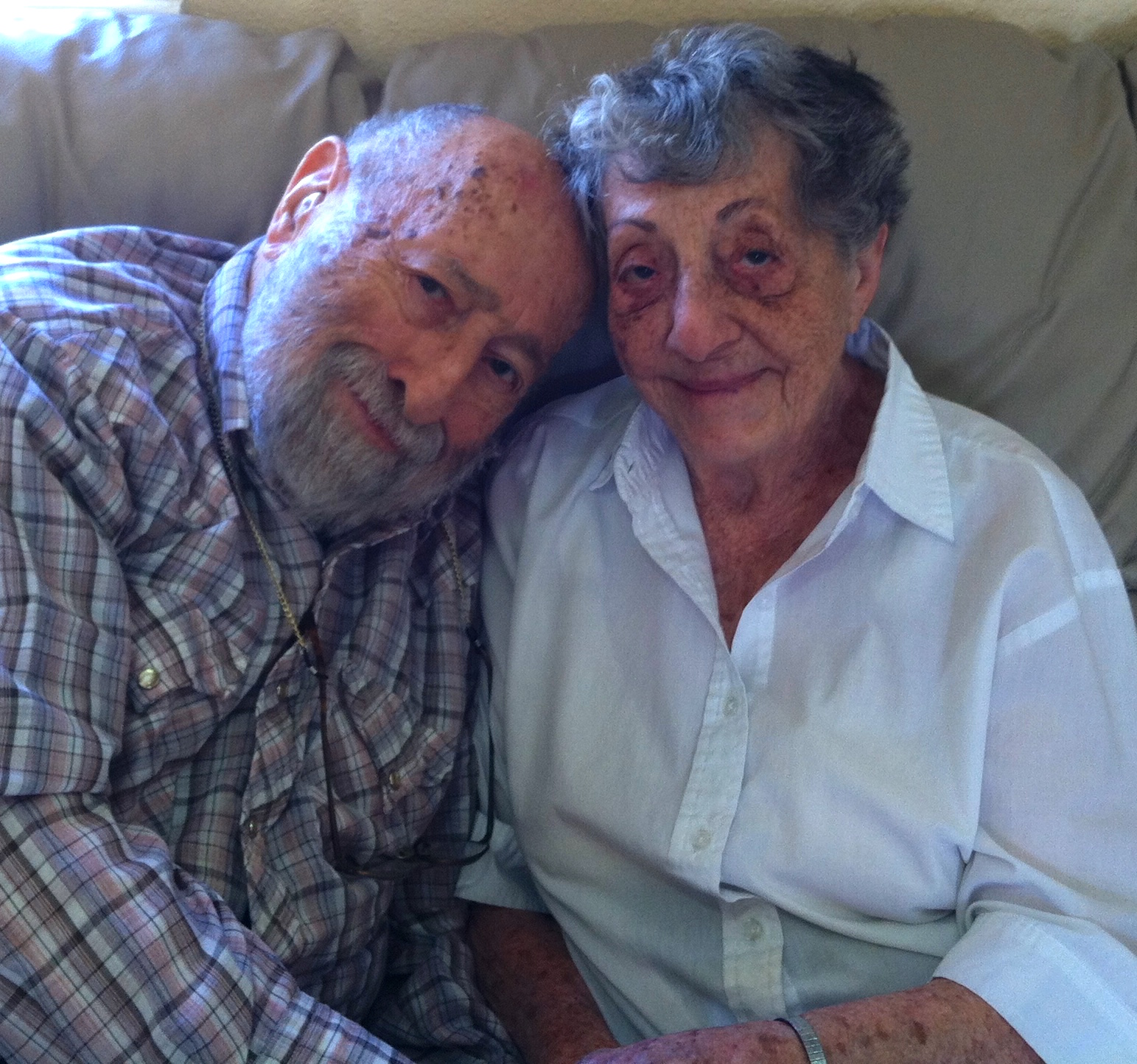
My father suffers from Alzheimer’s Disease. It’s a long, slow journey that he and our family have taken for years, with him progressively getting farther from us. My mother struggled hard against it, against the reality of losing the man she’d spent almost 60 years with, even though his body was still present. She was angry. All the time. Until she found out she was terminally ill. When that news hit her, she looked up at me from her hospital bed and said, “This won’t be so hard on Daddy, will it? He won’t really know.” And just like that, the anger that had consumed her for years, flowed away. She accepted what was, even embraced it, both his reality and hers. Weeks later, she died at peace.
I knew a couple, married long and loved each other deeply, but lived largely separate lives under the same roof. There was an unspoken, mutual agreement not to talk about the disappointments in their past, the barriers to closeness in their present. Until they found out she was terminally ill. Though it was a time of great physical pain for her and emotional pain for him, they opened their hearts to each other in a way they had not been willing to risk before. The last years of her life were a time of richness in their relationship. She died at peace, and some years later, he did too.
But do we have to wait to know our days are numbered before we accept what is? After all, our days are numbered. We just don’t know what that number is. I’m going to try to live my life more like Sandy. Not wait.
What are you waiting for?
by D. J. Green | Jun 1, 2016 | Ground Work
Most geologists I know have desks and shelves in their offices and homes littered with rocks and minerals. We’re perpetual kids who never give up our rock collections. One morning in the late ’80’s, I stood beside the desk of my officemate, Mike. He was telling me about his groundwater modeling project and I was updating him on the Superfund Remedial Investigation I was working on. While we talked, I idly picked up, looked at, and put down the various rocks lined up on his desk.
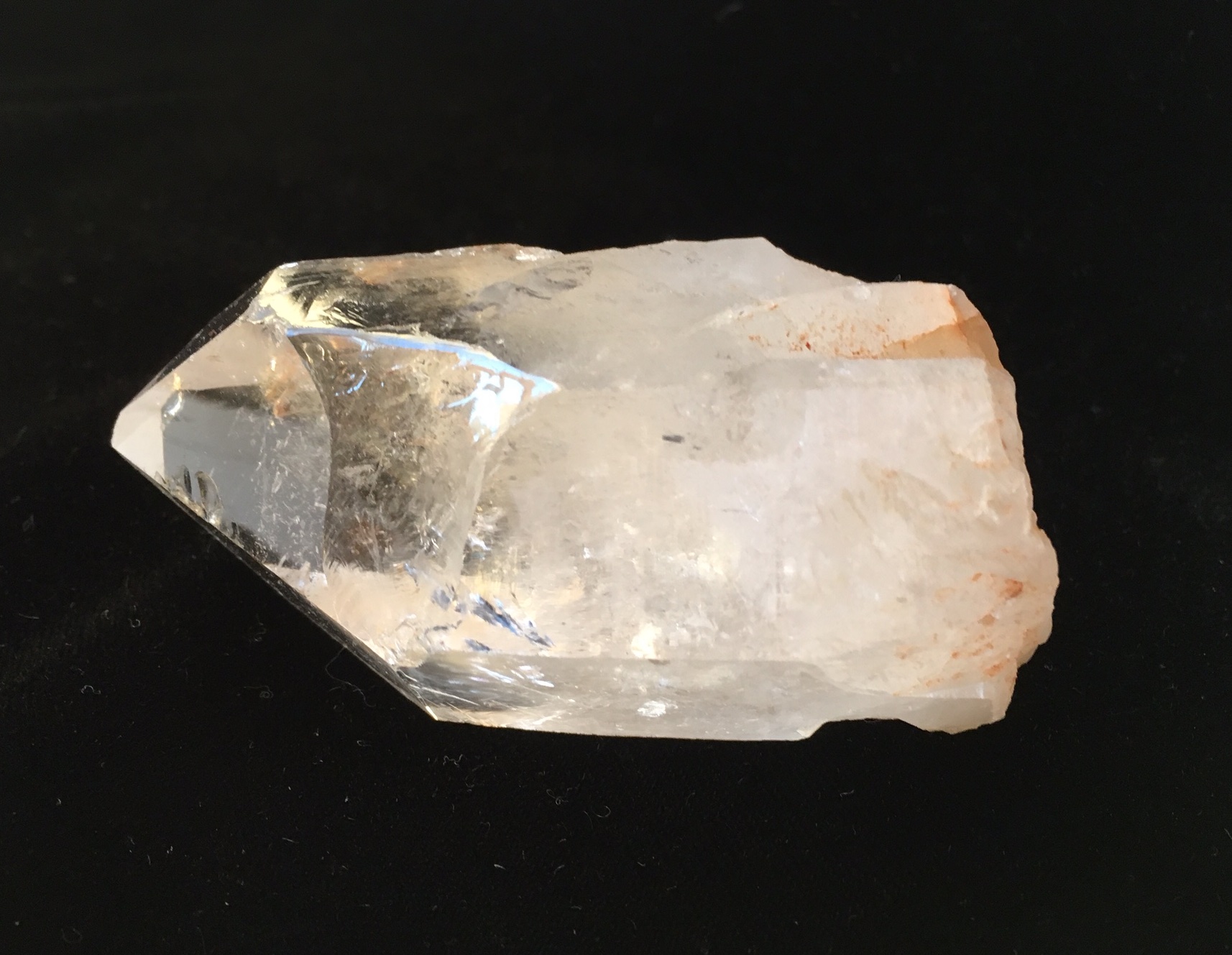
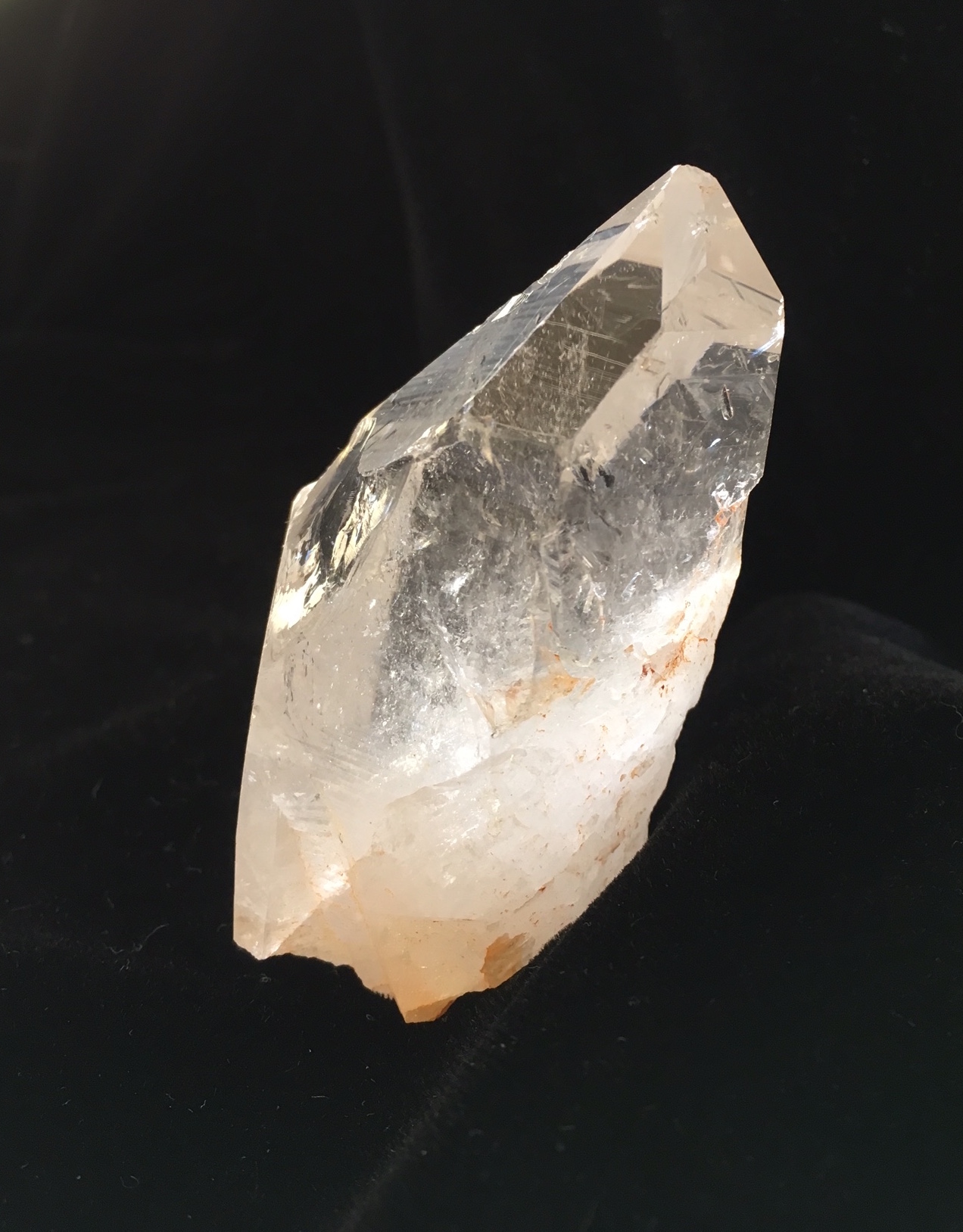
I lifted a quartz crystal at the end of his row of rocks. It was between three and four inches long, clear at one end, cloudy at the other. It wasn’t perfect, having a concoidal fracture where a crystal face should have been, but it was pretty. I weighed it in my hand, it fit neatly in my palm. My hand began to tingle. We continued to chat, and the sensation intensified as I held the crystal.
I interrupted our conversation to tell Mike what was happening. He smiled and said something about quartz having electrical impulses ala quartz crystal timing in watches.
Jasper
With a little research, I learned that the frequency at which a quartz crystal oscillates varies depending on its shape, size, and the crystal plane it’s cut on. There’s lots of information out there on how quartz crystals are used in modern timepieces. Briefly, quartz is accurately cut into a small tuning fork shape on a particular crystal plane so it oscillates at 32,678 hertz. If you’re old enough, you’ll remember when you had to wind your watch every day, those were mechanical watches. Quartz crystal timing is at least an order of magnitude more accurate than mechanical timing.
In the case of the uncut chunk of quartz on Mike’s desk, the shape and size and crystal plane just happened to resonate with my frequency.
“Well,” he said, “you better keep it. It doesn’t make me tingle.”
Smoky Quartz
Quartz is not an unusual mineral, in fact it’s one of the most usual minerals around. It’s abundant in the Earth’s continental crust, second only to the family of feldspar minerals. Most everyone has some sense of what quartz looks like. There’s microcrystalline quartz – like chalcedony, agate, onyx, and jasper, to name a few. There’s macrocrystalline quartz – sometimes called rock crystal (clear), rose quartz (pink), amethyst (varying shades of purple), and smoky quartz (varying shades of brown and gray), to name a few more. I imagine almost everyone reading this has at least one piece of quartz, and that’s outside their watches.
One of mine makes my hand tingle. Thirty years and three moves later, I still have it, it still works, and it still feels like the coolest thing ever (Thanks, Mike!). Knowing the science doesn’t diminish my delight in the least.
What resonates with you?
by D. J. Green | May 20, 2016 | Venus & Mars Go Sailing
I unzip the door of the giant blue canvas cover that blankets her through the winter, and step up onto the deck of the boat I’ve called my summer home for twelve years. Soon, the work will begin, but I settle for a moment in the blue-tinged light of the cockpit. I am home again.
I have two homes, two very different, very beautiful homes. Each place makes my heart sing, each to a different tune, though always the winds sing along, one through the junipers, the other through the rigging.
I was not called to the sea until I was a woman in the summer of my life, a woman who loved a man who loved the sea. He courted me across the country. He sent me Cruising World magazines, and asked me to marry and sail away with him. Though I only sailed with him one weekend on a small charter boat, his dream lived on in me after the accident that killed him.
Instead of making my way to the sea then, I made a home in the desert. A healing place that years later still nurtures me. But I dreamed. I dreamed of learning to sail. I dreamed of a boat I could sail myself. I read about boats, and I dreamed.
Seasons passed. I met another man who, like me, had lost a mate he loved. We came to know each other through grief. But we grew to love each other through the dream to sail. He sold a house and bought the perfect boat, an oceangoing cutter with lovely lines. When considering that decision, he meditated and found the message, “Move toward the light.” We named her Kagán, light in the Tlingit language. She has been a source of light ever since.
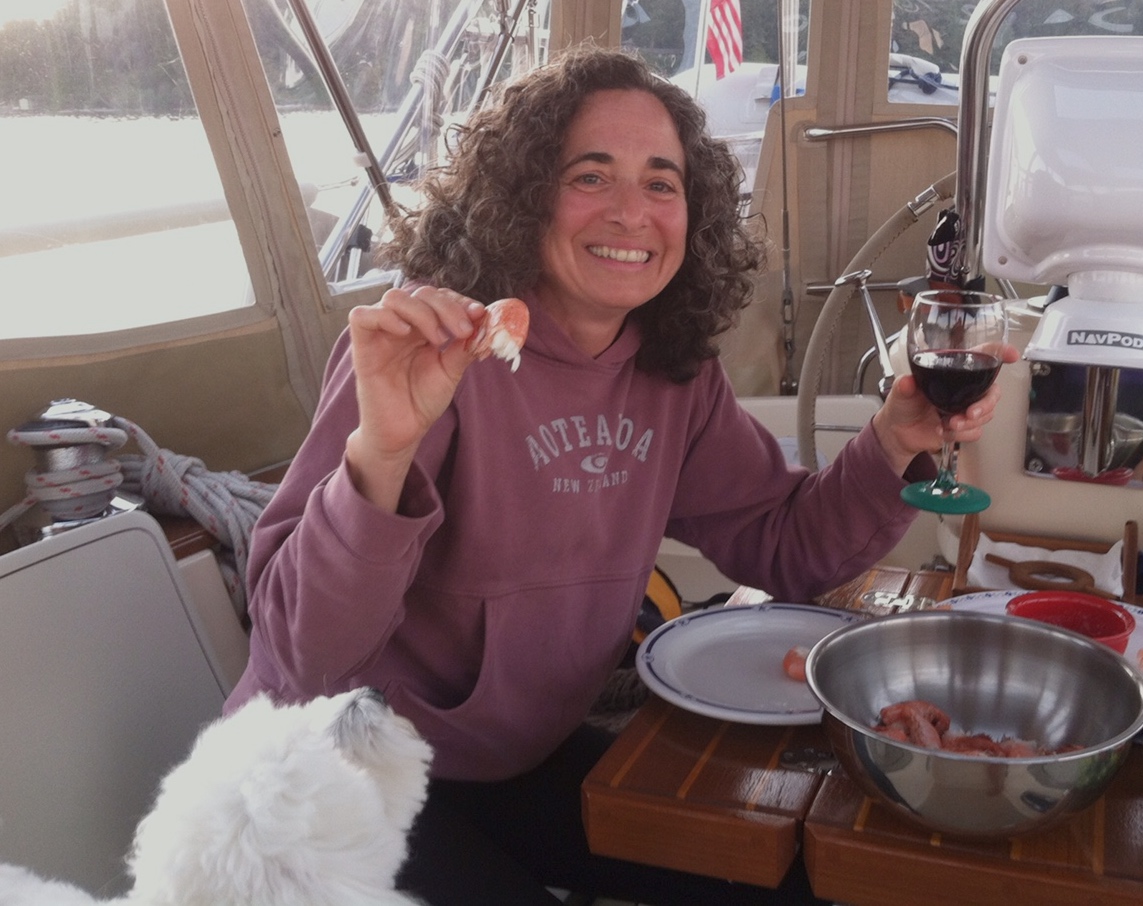
When that man was being taken by cancer, we held hands and talked of the adventures we shared for eight years on our fair little ship. The day in Thompson Sound that hundreds, maybe thousands, of Pacific White-Sided Dolphins leapt around us while we drifted. The beam reach across Baker Passage, going faster than hull speed, the boat in perfect balance, he on the helm wearing a mile-wide grin and me whooping with joy on the windward combing. The days at anchor, the only boat in the Susan Islets, waiting each evening for the black bear to come feast on the apples of the abandoned homestead on shore. Fresh prawns, hauled up from the deep in our traps, steamed then dipped in lemon butter, dinner for seven nights in a row, never tiring of their sweetness. The blessed hush when the engine goes quiet, and the sails take you home. Wherever home will be that night.
Is home a place? A person? A feeling?
I have found home in places that fill my heart with joy. I have found home with cherished partners, here and gone.
I am now in the autumn of my life, but it’s a warm, sunny spring in British Columbia and the sea is calling. I stand and pull the key ring from the pocket of my jeans. I unlock the padlock that’s kept Kagán secure through the winter, slide the hatch open, and lift the companionway boards out. I step down the ladder that I’ll run up and down a thousand times this sailing season. Hands on my hips, I look around the cabin and wonder where to begin, moving back home.
After eight years as Kagán’s First Mate, Deb Green took the helm as Skipper after her partner, Jerry Blakely, passed away in the spring of 2013. 2016 is her fourth season as Skipper. She sails with her boyfriend, new-to-sailing First Mate Eric Hubbard, and her intrepid little boat dog, Capi.

 I drank my tea, trying to swallow the anxiety spawned by the news and to-do’s along with it. Then Sandy and I headed out for our walk. He led me up the trail at sunrise, his fur ruffling in the chill breeze, his too-small-for-his-body ears bouncing with each step. A flock of Mountain Bluebirds, wintering in the junipers, took to the sky as we passed, the incredible color of their feathers flashing.
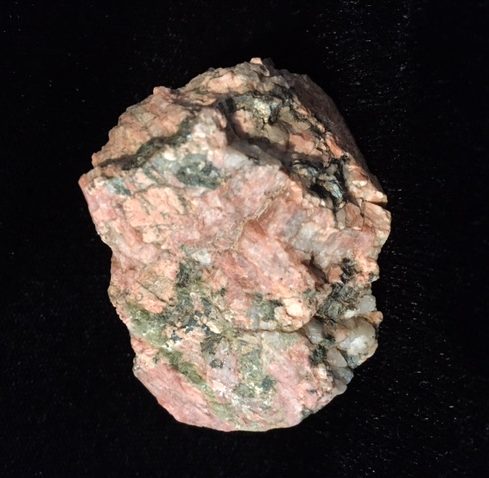 giving the range its nickname – the Watermelon Mountains.
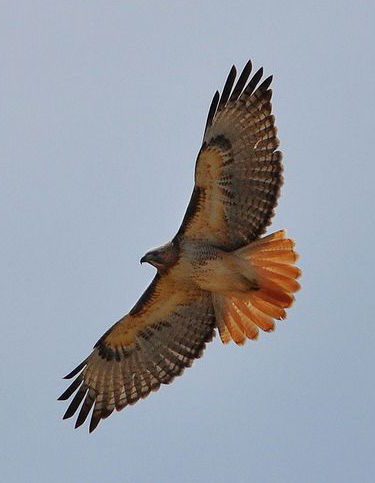 When I remember to live like that, in addition to having the courage to try, whether I succeed or fail, there’s also space to savor the finger snaps of my own lifetime – a walk with my beloved dog, making tracks in fresh snow, Sirius sparkling in a black velvet sky, Wynton Marsalis playing Where or When, a hawk soaring overhead, reading Mary Oliver’s Wild Geese, and the glint of a mountain moonrise. In those moments, my heart fills with gratitude – it feels physical, like my heart is actually swelling in my chest. Have you ever felt it?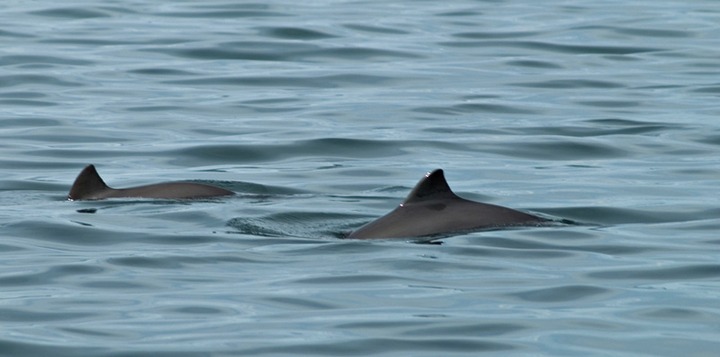






Recent Comments